Dysphagia Case Study: Navigating silent aspiration and NPO status
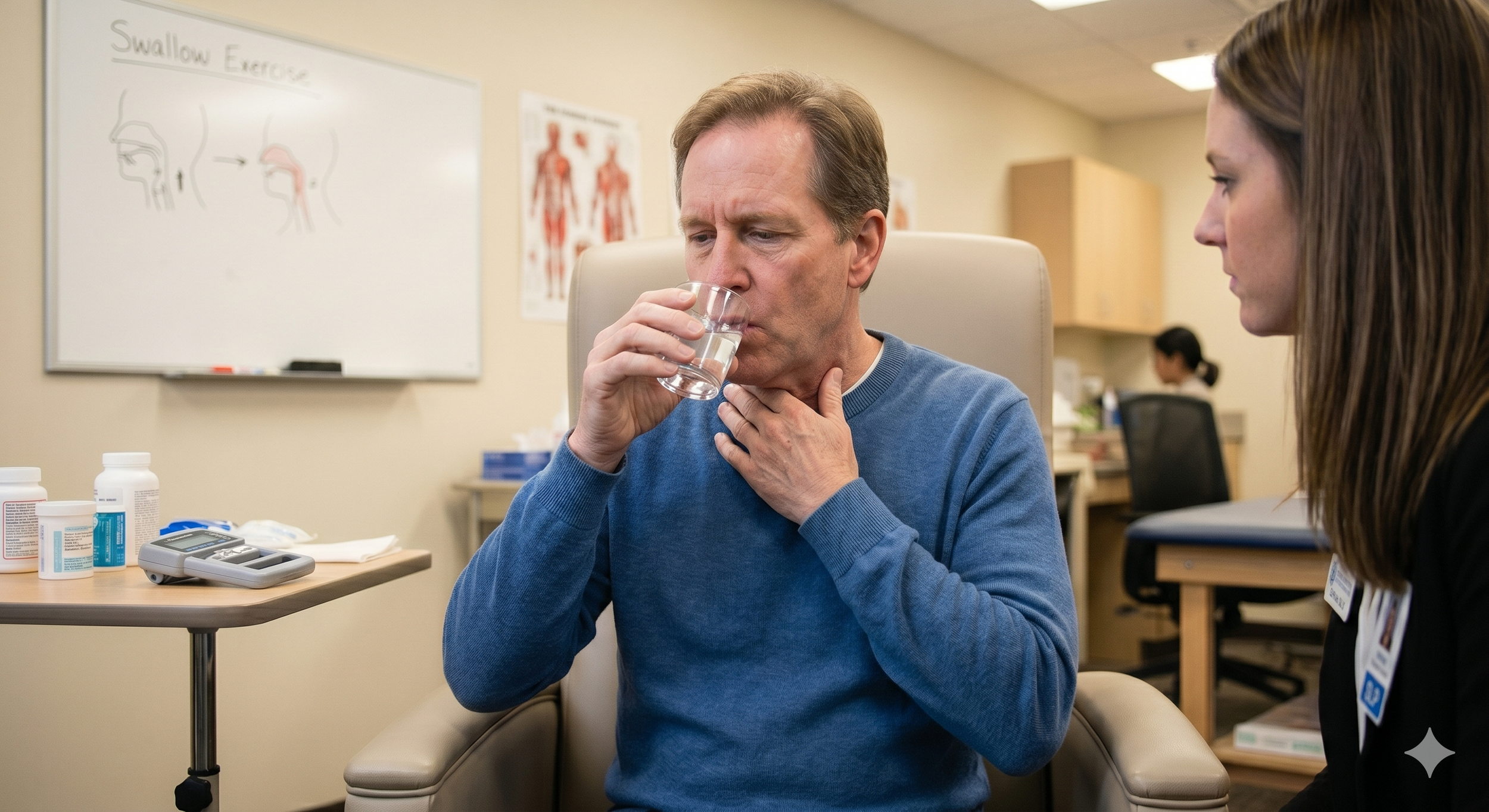
Benny is a 54-year-old patient who presents with severe oropharyngeal dysphagia secondary to chemoradiation for head and neck cancer. Due to his physiologic impairments and high aspiration risk, he is strictly NPO and dependent on a PEG tube for nutrition.
You’re seeing Benny for the first time. What’s your first step in managing this patient’s dysphagia?
Take a minute and don’t scroll down! What will you do next?
a. Referral to oncology
b. Removal of the feeding tube
c. A clinical swallowing evaluation
d. A modified barium swallow study
.
.
.
.
.
The answer: c
That’s right! Take a look at the bedside first to see what’s going on. And that’s exactly what you do. You find that the patient has no neurological involvement, but does have some generalized weakness and decreased range of motion. Small amounts of puree and thin liquids by the teaspoon are tolerated without issue.
Ok, what's the next best step now?
a. ENT referral
b. A modified barium swallow study
c. Discussion with GI
d. Discussion with the family about advancing PO intake
.
.
.
.
.
Answer: d
Yes! We need an instrumental swallowing evaluation to see what’s going on. I’ll see you there…
The MBSS:
We are in the videofluoroscopy suite, watching Benny’s performance on the screen. He presents with disorganized bolus formation/control, posterior bolus loss with extended pooling in the pyriform sinuses prior to the pharyngeal trigger. We are also seeing incomplete laryngeal vestibular closure, reduced laryngeal elevation, and poor tongue base retraction, resulting in significant post-swallow pharyngeal residue, as well as shallow transient laryngeal penetration with mildly thick liquids in 2 of 2 trials and a moderate amount of aspiration with thin liquids in 1 of 3 trials, resulting in a strong cough reflex.
Based on these observations of his pathophysiology, what is the best plan of care?
a. Training on compensatory strategies
b. Pharyngeal strengthening exercises
c. Lingual strengthening exercises
d. All of the above
.
.
.
.
.
Answer: d
Correct. Let’s get the most bang for our buck and try a multifaceted approach. By targeting pharyngeal and lingual strength training and using compensatory strategies to improve safety, we are adopting a comprehensive approach to dysphagia management. Why use just one tool when you have an entire toolbox filled to the brim with possibilities?
And what specific compensatory strategies would you try during the modified barium swallow study, given Benny’s deficits?
a. Supraglottic swallow
b. Chin tuck
c. Right head turn
d. Left head turn
.
.
.
.
.
Answer: a
Why wouldn’t a chin tuck strategy work, do you think? What about using a chin tuck might be contraindicated in a patient with pooling in the pyriform sinuses prior to the swallow? Think about it first and try to come up with an answer before scrolling down.
.
.
.
Leaning forward with pyriform sinus residue essentially turns the pyriform sinuses into a teakettle and the airway into the teacup. That’s definitely something we want to avoid.
A targeted intervention approach after the MBSS has two parts.
Part 1: Compensatory Interventions
Compensatory strategies are frontline tactics designed to immediately improve the safety and efficiency of the swallow by adapting to the impairment, rather than directly changing the underlying physiology.
To safely introduce therapeutic PO trials, Benny was instructed to utilize a super-supraglottic swallow. The super-supraglottic swallow requires an effortful breath hold that brings the arytenoids forward, effectively closing the laryngeal vestibule entrance before and during the swallow to prevent airway invasion. This maneuver provides increased and prolonged laryngeal vestibule protection compared to a standard breath hold. And by following up with a strong cough, you ensure that even if something sneaks in before, during, or after the swallow, as much as possible can be pushed out. Turns out, this is a very effective approach for Benny.
Part 2: Rehabilitative Retraining
While compensation mitigated his immediate aspiration risk, physical retraining is also needed to facilitate motor skill acquisition and improve his swallow physiology. This targeted retraining is grounded in the principles of experience-dependent neuroplasticity and exercise physiology. While most research guidelines have been developed for skeletal muscle, the principles remain helpful for guiding us in the hydrostatic muscles of the mouth and throat.
Because Benny had been an NPO, his musculature was highly susceptible to disuse atrophy. Muscle atrophy—particularly the degradation of fast-twitch (Type II) fibers that are critical for safe and efficient swallowing—can occur within the first 72 hours of disuse or changes in muscle workload. 72 hours!
Think about it this way: If a patient is admitted to your facility on a Monday, by Thursday, they’ll begin to show signs of atrophy and weakness.
To reverse this decline, we need to apply key principles of neuroplasticity:
Use It and Improve It: Training that targets a specific brain function enhances that function.
Specificity: Swallowing begets better swallowing. Because swallowing recruits specific motor units, training a distinct swallowing task is required to reinforce the appropriate neuronal pathways.
Want to swallow better? Then swallow… a lot.
Keeping this in mind, as well as Benny’s specific deficits, what are the best exercises to include in his routine?
a. Effortful swallow
b. Mendlesohn maneuver
c. Masako maneuver
d. Chin tuck against resistance
e. A, B, and C
.
.
.
.
.
Answer: e
If we want swallowing to get better, we swallow more. And more. And more! Unless there is pain or discomfort. Increasing the frequency of swallowing with resistance, however we can, is the best approach to improving the swallow.
What about all those other swallow exercises that don’t involve swallowing? Let’s take chin tuck against resistance, for example: While helpful in strengthening the suprahyoid muscles to target laryngeal elevation and cricopharyngeal segment opening, it’s still not active swallowing, and so is less in line with the exercise principles we just discussed. If you have the time to throw that one in there, go for it! But always prioritize swallowing-related tasks if possible.
So, to directly address Benny's specific physiologic deficits, the following evidence-based maneuvers were implemented:
Effortful Swallow: Utilized to increase the extent and duration of oral and pharyngeal pressures, while specifically targeting improved tongue base retraction and posterior pharyngeal wall movement.
Mendelsohn Maneuver: Implemented to increase the extent and duration of anterior hyoid excursion, laryngeal elevation, and pharyngoesophageal segment (PES) opening.
Masako Maneuver: Incorporated to recruit and increase the contraction of the posterior pharyngeal wall during the swallow.
After beginning the exercises, Benny expresses frustration with how abstract they are. “How do I know if I’m doing it right? How do you know if I’m doing it right?” he asks. Great question! We don’t.
Because of this, you decide to talk to the administration of your facility to see if they’ll purchase a device.
What device might help you in this capacity?
a. EMST
b. sEMG biofeedback
c. Provale Cup
d. Ligual strengthening device
.
.
.
.
.
Answer: B
Yes! Because swallowing happens behind the curtain of skin, fat, and muscle tissue, it’s difficult to establish intrinsic feedback systems. Surface electromyography (sEMG) biofeedback is a perfect solution for this and comes in many forms. One was purchased for Benny, allowing him to visually monitor his submental muscle activation and ensuring he sustained laryngeal elevation for the targeted 3 to 5 seconds during the Mendelsohn maneuver.
Case Conclusion and Outcomes
Benny adhered to his intensive dysphagia rehabilitation program, completing structured sessions 3 to 5 times per week alongside independent daily practice. By strictly applying the principles of neuroplasticity, specificity, and exercise physiology to his targeted maneuvers, Benny’s swallowing musculature underwent significant physiologic adaptation.
Following 12 weeks of intervention, a follow-up MBSS demonstrated complete laryngeal elevation and vestibular closure, as well as improved pharyngeal stripping and bolus clearance. Benny successfully met his long-term clinical goals: his PEG tube was removed, and he was able to safely meet all nutritional needs by mouth on a minced and moist diet (IDDSI 5) with thin liquids (IDDSI 0) without airway compromise. Success!